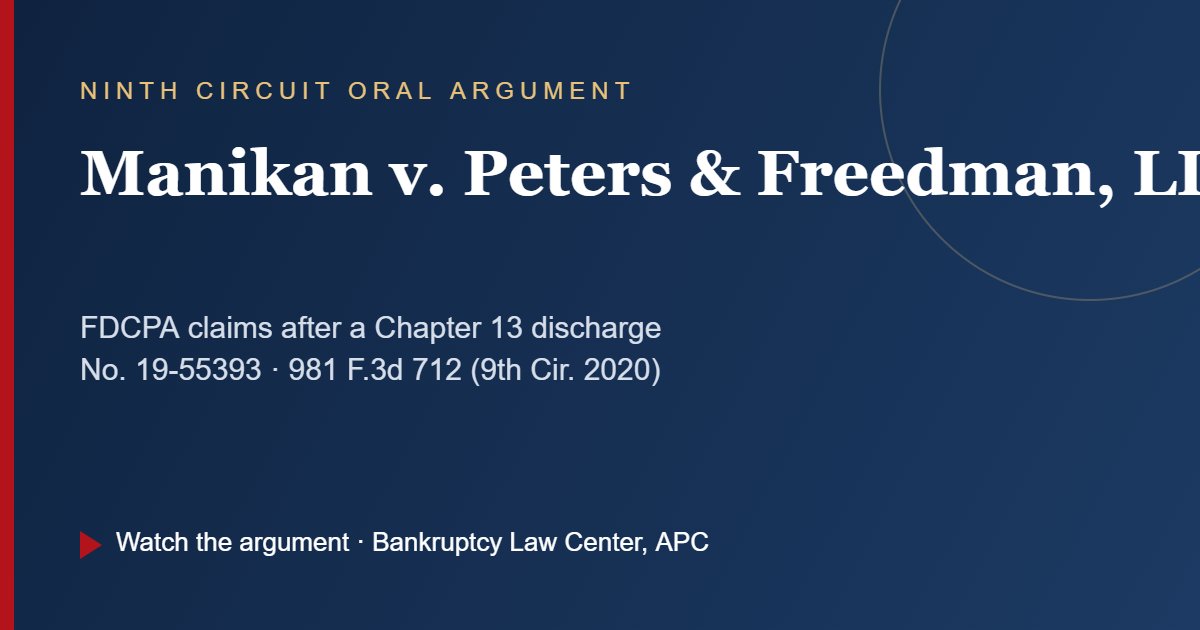
Manikan v. Peters & Freedman: FDCPA Claims Survive Bankruptcy
The Ninth Circuit held that a debtor who paid a debt through a Chapter 13 plan can sue a collector under the FDCPA for trying to collect it again. BLC's…

Short answer: Yes. In Manikan v. Peters & Freedman, L.L.P., 981 F.3d 712 (9th Cir. 2020), the Ninth Circuit held that a debtor who paid a debt in full through a Chapter 13 plan can sue the collector under the Fair Debt Collection Practices Act (FDCPA) when it later tries to collect that same debt. The bankruptcy discharge does not swallow the claim. Bankruptcy Law Center’s Ahren A. Tiller was counsel of record for Mr. Manikan on the appeal.
For almost twenty years, debt collectors in the Ninth Circuit leaned on a 2002 decision, Walls v. Wells Fargo Bank, to argue that once a debt was discharged in bankruptcy, the debtor’s only remedy for later collection attempts was contempt in the bankruptcy court. Under that reading, the FDCPA, with its statutory damages and attorney’s fees, was off the table. Manikan drew a line around Walls. If the collection attempt is unlawful for a reason that has nothing to do with the discharge order, for example because the debt was already paid, the FDCPA claim survives.
Vincent Manikan owned a home in San Diego in the Pacific Ridge Neighborhood Homeowners’ Association. In 2009 he fell behind on his HOA dues. The HOA’s law firm and debt collector, Peters & Freedman, LLP, sent collection notices, recorded a lien for $1,539 plus assessments and costs, and then recorded a Notice of Default and Election to Sell, starting a nonjudicial foreclosure.
Mr. Manikan filed Chapter 13. His confirmed plan paid the HOA arrears, and he paid his ongoing dues directly. In March 2014 the HOA’s property manager told the Chapter 13 trustee the debt was “paid in full.” The trustee adjusted the claim, deemed it fully paid, and later filed a Notice of Final Cure Payment confirming the HOA debt was satisfied. The bankruptcy court then entered his discharge.
Nearly two years after the debt was paid, Peters & Freedman hired a process server to re-serve the 2012 Notice of Default. According to the opinion, the process server broke through a closed gate into the backyard, banged on the windows, and startled Mr. Manikan, his cousin, and his elderly mother. Someone in the house called the police. Mr. Manikan told the firm the debt was paid. The firm later admitted that no balance was owed when it hired the process server.
Mr. Manikan sued under the FDCPA. The district court granted summary judgment to the law firm, concluding that his claims were precluded “because they are premised upon violations of the bankruptcy post-discharge injunction.” In other words, the court treated this as a discharge-violation case that belonged in bankruptcy court, not an FDCPA case.
The Ninth Circuit reversed. Writing for the panel, Judge Hunsaker framed the question as whether a debtor is barred from an FDCPA claim “when the debt at issue was fully satisfied through a Chapter 13 plan before discharge was entered.” The court answered no: “Walls does not preclude FDCPA claims in such circumstances because whether an unfair debt collection practice occurred does not depend on issuance or enforcement of the discharge order.”
The court explained that Mr. Manikan “does not seek to remedy a violation of his discharge order. Instead, he alleges P&F acted unlawfully because it tried to collect a debt that he fully paid nearly two years before his discharge.” Even if he had never received a discharge, the collection attempt would still have been unlawful. His FDCPA claims therefore rested on “a wholly independent theory of relief,” and Walls “does not bar independent theories of recovery whenever violation of the discharge order also is a potentially available theory of recovery.”
The court also addressed Mr. Manikan’s harassment claim under 15 U.S.C. § 1692d, which targets the collection techniques used rather than the fact that the debt was paid. That claim, too, was “wholly independent from the bankruptcy discharge order.” The grant of summary judgment was reversed and the case remanded for further proceedings. The appellate court did not decide whether the firm ultimately violated the FDCPA; it held only that Mr. Manikan was entitled to pursue the claims.
The FDCPA prohibits a debt collector from using “any false, deceptive, or misleading representation or means in connection with the collection of any debt,” including misrepresenting “the character, amount, or legal status of any debt” and threatening “any action that cannot legally be taken.” 15 U.S.C. § 1692e. A collector that violates the Act is liable for actual damages, additional statutory damages of up to $1,000 for an individual, and the consumer’s costs and reasonable attorney’s fees. 15 U.S.C. § 1692k.
After Manikan, a collector cannot avoid those remedies simply by pointing out that the consumer went through bankruptcy. The practical takeaways:
Ahren A. Tiller was counsel of record for Mr. Manikan in the Ninth Circuit and briefed the appeal. The case is an example of why the firm treats consumer protection litigation as part of its bankruptcy practice: the same creditors and collectors who appear in a Chapter 7 or Chapter 13 case often keep collecting after the case is over, and the FDCPA and California’s Rosenthal Act give clients a way to hold them accountable. The California Lawyers Association’s summary of the decision is available for readers who want a bar-association perspective.
The Ninth Circuit posts video of its oral arguments. You can watch the argument in this case, 19-55393 Vincent Manikan v. Peters & Freedman, LLP, on the court’s official YouTube channel, or below.
Do not pay it again. Gather your plan, the trustee’s final report or Notice of Final Cure, and any letters or voicemails from the collector, and talk to a bankruptcy attorney. Under Manikan, an attempt to collect a debt that was paid through the plan can support an FDCPA claim.
Not by itself. Under Walls, a claim that is simply “the collector violated my discharge order” belongs in bankruptcy court. But if the collection attempt is unlawful for an independent reason, such as the debt being paid, the FDCPA claim can proceed.
In Manikan, the law firm collecting for the HOA was treated as a debt collector, and the FDCPA claims were allowed to proceed. Whether a particular collector is covered depends on the facts.
The statute provides for actual damages, up to $1,000 in additional statutory damages in an individual action, and costs and reasonable attorney’s fees in a successful action. 15 U.S.C. § 1692k.
If a creditor or collector is pursuing a debt you already paid or discharged, Bankruptcy Law Center can review your case at no charge. We handle Chapter 7 and Chapter 13 cases throughout Southern California and litigate FDCPA and Rosenthal Act claims on behalf of consumers. Call 800-551-7922 for a free consultation.
Prior results do not guarantee a similar outcome. This article is general information, not legal advice.










Legal Disclaimer: The Bankruptcy Law Center is a California Licensed law firm with attorneys licensed in the state of CA. Attorney Ahren Tiller is responsible for this advertisement. Bankruptcy Law Center’s principal office is located at 1230 Columbia St. Suite 1100 San Diego, CA 92101. Prior results listed on this site do not depict or in any way infer a prediction or outcome. Bankruptcy Law Center is a debt relief agency proudly providing options to people with financial problems. View our Privacy Policy and Our Terms and Conditions.
© 2026 All Rights Reserved.